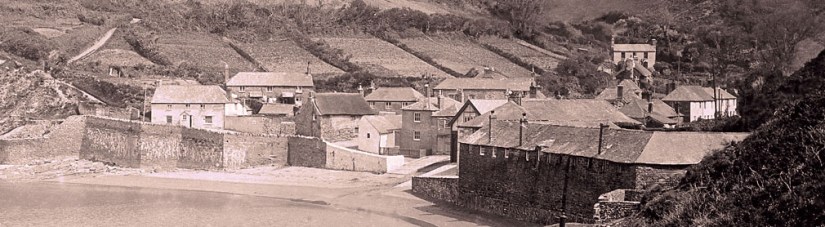
- Polkerris in about 1910 shortly before a storm destroyed most of the sea wall, the General Elliott pub (far left) and the thatched cottage to the right. On the right are two large pilchard curing cellars or ‘palaces’. The upper floor of one now was the village school while part of the other cellar had been converted into a house
Tucked away in the north-east corner of St Austell Bay, Cornwall lies the little village of Polkerris. In the 18th century the bay was called the Bays of Mevagizey and Polkerris, the village’s significance then arising from a flourishing pilchard fishery which had developed since the late 16th century when the Rashleigh family bought extensive lands on the beautiful Gribbin peninsula and built Menabilly. For more than four centuries the village has remained part of the Menabilly Estate.
At the bottom of a short steep wooded valley, the core of the village is clustered behind a sandy cove partly sheltered by the curved arm of the old stone pier. Best approached from high on the coast paths, the village’s sequestered sylvan setting contrasts with the surrounding agricultural landscape. It’s a small village, little more than a hamlet, of fifteen cottages – there were many more in the 19th century – and strikingly there are no new houses.
In the 18th century a more populous Polkerris had a thriving pilchard fishery which had been in existence since the late 16th century, if not earlier. Development of the fishery stemmed from the acquisition by John Rashleigh of much of the Gribbin peninsula, together with Robert Rashleigh’s acquisition of Tregaminion, between 1569 and 1579 and the building of Menabilly to which John Rashleigh II moved in 1601. From here he continued to direct his many trading and shipping activities.
John II used Polkerris, along with cellars in Fowey, as the base for a complex engagement with the pilchard fishery as owner or part-owner of seines (nets) and boats, employer of seiners (fishermen), fish buyer, curer and exporter. Many other people, mainly from Tywardreath and Golant, fished from Polkerris and the village developed during the 17th century as these fishermen, or part-time fishermen, built cellars, stores and dwelling-houses. 1644 brought the disruption of the Civil War and the Battle of Lostwithiel when Menabilly was sacked and the surrounding area plundered.
Later Rashleighs had varying degrees of involvement with the fishery. Jonathan Rasheigh I (John II’s successor) leased out his father’s cellars and neither caught nor cured pilchards although he did, in partnership with others, export them. Nevertheless, with some fluctuating fortunes, the fishery continued and the village grew to something like twice its present density. Leases from the beginning of the 17th century to the middle of the 18th century tell of the early preponderance of buildings associated with the fishery giving way to more residential development. From time to time disputes arose over tithes and ‘keyage’ and fishermen built up considerable arrears of payments to the Rashleighs as tithe and quay owners. In the early 18th century these included Quakers, one being Philip Rashleigh II’s own agent. The rights to tithes and to charge ‘keyage’ were tested in court proceedings and legal opinions and it may be that these difficulties contributed to a distinct change in the Rashleighs’ involvement with the fishery. From the middle of the 18th century they owned outright their own Polkerris pilchard seine in contrast to the usual shareholding form of seine ownership. The ‘Polkerris Sean’ was run by agents and surviving accounts provide an insight into the organisation and economics of the fishery, the profitability of which was often dependent upon government subsidy or ‘bounty’. Other seines were based at Polkerris, the ‘Good Heart’ being one, a typical shareholding enterprise. More continued to operate here well into the 19th century but by this time the ‘Polkerris Sean’ had ceased operation and it appears that in 1866 the cove’s last seine was shot.
under construction
 Polkerris History